Postpartum lower back pain is common, and it often settles over the first months. It comes from a body that is still reorganising after pregnancy while it lifts and carries a newborn all day, and it is not a sign that you did something wrong. Gentle movement and a few changes in how you lift and sit can ease it, and the warning signs below mean you see a doctor first.
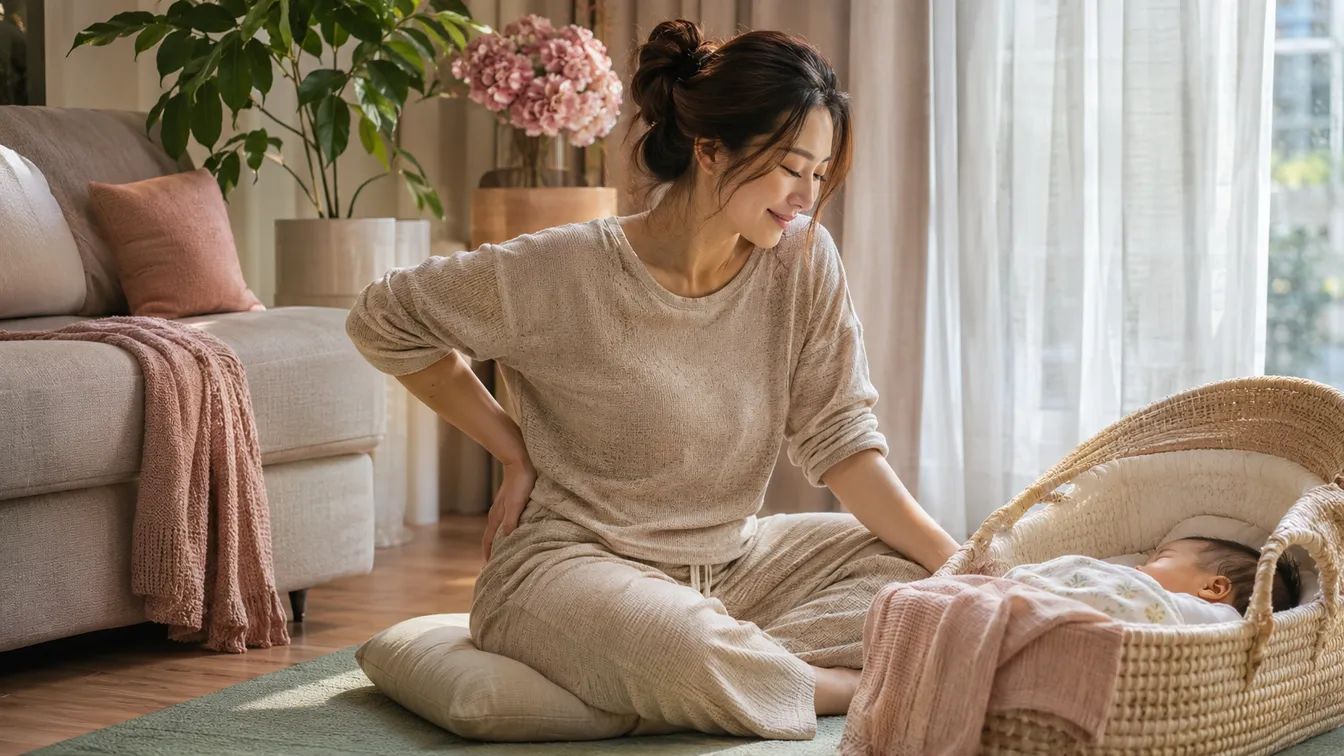
You probably know when it shows up: bending over the cot to lay the baby down, or sitting through the 3 a.m. feed with your shoulders curled forward. Those moments are clues, and they are where the gentle changes below begin.
Is lower back pain after giving birth normal?
Yes, and you are in large company. In a 2024 survey of 373 mothers at a public primary care clinic in Singapore, 59.3% reported lower back pain at least sometimes at their baby's 4 to 8 week check, second only to fatigue. Estimates vary with how pain is defined, and a pooled review put it at about one in four women after pregnancy.
In a Swedish study of 817 women, more than two thirds had back pain straight after delivery, and most of those who recovered were pain-free within six months. A 2020 meta-analysis calls the usual course favourable, with a subgroup whose symptoms last. Both studies list back pain before pregnancy and physically heavy work among the predictors. None of that is a verdict on your body. If either applies to you, it is a good reason to ask for help early.
Why does my lower back hurt after giving birth?
Nobody has pinned down a single cause, and a systematic review of pregnancy-related back and pelvic pain says the mechanisms remain unclear. The load picture is clearer. During pregnancy the ligaments soften to prepare for labour, which the NHS notes can strain the joints of the lower back and pelvis. After birth that structure is still adjusting, and the baby adds a daily load: lifting from low surfaces and feeding in a curled-forward position.
Dr. Jacqueline Yun of Inner Heal Transformation, who holds a PhD in Mechanical Engineering from NTU, reads this pattern structurally. When the hips tighten from long stretches of sitting and nursing, and the upper back stiffens into a forward curve, the lower back bends in their place. It is the same compensation she describes in why your back hurts at a desk job.
You may have read that a diastasis causes back pain. In one 2025 ultrasound study of 197 mothers, the abdominal gap was not significantly correlated with low back pain at six months, so a wide gap is not a reliable explanation for a sore back. The one-minute coning self-check is in how to check for diastasis recti at home, and the 12-week postpartum guide covers the wider changes.

What helps lower back pain after giving birth?
These steps aim to ease the ache. They do not treat any condition, and your doctor's advice comes first.
- Keep moving, gently. The NHS advises staying active. ACOG says it is usually safe to begin exercising a few days after an uncomplicated vaginal birth, or as soon as you feel ready. Even 10 minutes benefits your body, it adds. After a caesarean or any complication, ask your doctor first, and stop if the pain gets worse.
- Use heat for stiffness. The NHS suggests a heat pack or hot water bottle wrapped in a tea towel.
- Check before taking painkillers. Anti-inflammatory medicines may not suit everyone, the NHS notes, so ask a pharmacist or doctor and mention that you are breastfeeding.
- Add guided strengthening once cleared. A 2025 review in the British Journal of Sports Medicine pooled 37 postpartum exercise studies. It found moderate-certainty evidence that exercise, including trunk strengthening, lowered low back and pelvic pain scores by about 2.2 points out of 10 versus no exercise (four trials, 210 women).
How should I lift, carry and feed my baby?
The NHS writes its back-care advice for pregnancy, and a hospital leaflet says to look after your back the same way after birth. Bend your knees and keep your back straight when you pick the baby up from the floor or a low cot. Move your feet when you turn, to avoid twisting your spine. When you sit to feed, keep your back well supported and put pillows under the baby so you are not curling forward to reach. If you carry the baby on one hip, switch sides now and then.
When should I see a doctor or physiotherapist?
A hospital leaflet on care after anaesthetic for delivery says back pain after childbirth is almost always caused by pregnancy or childbirth and sometimes lasts several months. Occasionally it is something else. The table adapts that leaflet and the NHS back pain guidance, and adds Singapore's emergency number from SCDF.
| What you notice | What to do |
|---|---|
| Weakness, numbness or tingling in both legs, loss of feeling around the genitals or anus, trouble passing urine or controlling your bladder or bowels, or chest pain | Go to an emergency department now, and do not drive yourself. Call 995 if no one can take you. |
| Back pain with fever or feeling generally unwell, severe pain that starts suddenly or worsens quickly (including after an epidural or spinal), or weakness or numbness in one leg | Get medical advice the same day from your doctor or your delivery hospital. |
| Pain that has not improved after a few weeks of self-care, stops you doing daily tasks, is worse at night or not eased by rest, or sits between the shoulder blades | Book a doctor's visit and ask for a referral to a physiotherapist. |
Leaking when you cough or a heavy, dragging feeling low in the pelvis are also questions for a pelvic-health physiotherapist, as the diastasis self-check explains. Some pain that feels like lower back pain is pelvic girdle pain, which researchers treat as a separate problem. In a systematic review, about half the mothers with pregnancy-related pain had pelvic girdle pain alone, and the other half had low back pain, alone or together with pelvic girdle pain. You cannot tell which is which from the sofa, so see a physiotherapist who works with women after birth. If the pain is new, severe or unexplained, physiotherapy comes before yoga, and yoga, physiotherapy or chiropractic sets out the order.
Can yoga help with postpartum lower back pain?
Gentle, guided movement can help, and the NHS lists yoga among the activities that may ease back pain. The trials above included trunk strengthening, so they support guided movement in general. They do not show that one method beats another. Yoga is not a treatment for any condition, and it starts after your postnatal clearance.
At Inner Heal, Dr. Yun, who has taught for more than ten years, works in a set order: joint mobility first, then posture correction, then muscle strength, as set out in the three-element framework. For a lower back covering for stiff hips and a stiff upper back, the hips and upper back come first.
Group classes run live on Zoom for 60 minutes, themed by week and small enough for Dr. Yun to correct your posture through the camera. A one-to-one session starts with a Movement and Posture Assessment, which suits you if you would like someone to look at your own pattern first. Workshops have covered postpartum recovery, and you can ask to hear about the next one. It is all on the classes page, and if you are still in your first weeks, start with how long after giving birth before you can start yoga again.
The ache has a pattern, and a pattern is something you can work with.
Frequently asked questions
How long does postpartum lower back pain last?
It varies. In the Swedish study, most of the women who recovered were pain-free within six months, and 37% still had back pain at least 12 months after delivery. If yours has not improved after a few weeks of gentle self-care, or it stops you doing daily tasks, see a doctor. Pain that lasts is worth getting assessed.
Did my epidural cause my back pain?
Current evidence does not link epidurals to long-term back pain. A Cochrane review found no difference in long-term backache between women who had an epidural and women who did not (two trials, 814 women, moderate-certainty evidence). Soreness where the needle went in is common for a few days, but new or severe back pain after an epidural or spinal, or weakness or numbness in the legs, needs medical advice the same day.
Can I do yoga while my lower back still hurts?
Often yes, once you have postnatal clearance and the movement is gentle enough that the pain does not sharpen. The NHS says to stop if exercise makes back pain worse and to see a doctor. Tell the teacher you are postpartum before class, and read postpartum poses to avoid for the five poses that commonly cause coning after birth.
Does a caesarean make back pain more likely?
Not on the evidence so far. A small 1994 study of 160 women found no difference in postpartum back pain between caesarean with spinal anaesthesia and vaginal birth. A caesarean does follow a longer timeline for loading the abdomen, so ask your doctor about your incision before you start exercise.
Sources
- NHS, Back pain, last reviewed 5 March 2026.
- NHS, Back pain in pregnancy, last reviewed 10 January 2024.
- University Hospitals Coventry and Warwickshire NHS Trust, Care after your anaesthetic for delivery, updated August 2025.
- Royal Wolverhampton NHS Trust, Back pain and pregnancy, patient leaflet produced 2021.
- ACOG, Exercise After Pregnancy, FAQ131, last reviewed October 2024.
- SCDF, Emergency Medical Services, call 995 for emergencies.
- Ng C, Szücs A, Goh LH. Common maternal health problems and their correlates in early post-partum mothers. Women's Health, 2024. PMID 38282548.
- Ostgaard HC, Andersson GB. Postpartum low-back pain. Spine, 1992. PMID 1531555.
- Wu WH et al. Pregnancy-related pelvic girdle pain (PPP), I: terminology, clinical presentation, and prevalence. European Spine Journal, 2004. PMID 15338362.
- Wiezer M et al. Risk factors for pelvic girdle pain postpartum and pregnancy related low back pain postpartum. Musculoskeletal Science and Practice, 2020. PMID 32560862.
- Chen H et al. Evaluation of rectus abdominis muscle using high-frequency ultrasound and shear wave elastography to construct a risk prediction model for postpartum low back pain. Academic Radiology, 2025. PMID 39521631.
- Ruchat SM et al. Impact of exercise on musculoskeletal pain and disability in the postpartum period. British Journal of Sports Medicine, 2025. PMID 39922568.
- Anim-Somuah M et al. Epidural versus non-epidural or no analgesia for pain management in labour. Cochrane Database of Systematic Reviews, 2018. PMID 29781504.
- Wang CH et al. Comparison of the incidence of postpartum low back pain in natural childbirth and cesarean section with spinal anesthesia. Acta Anaesthesiologica Sinica, 1994. PMID 7894920.